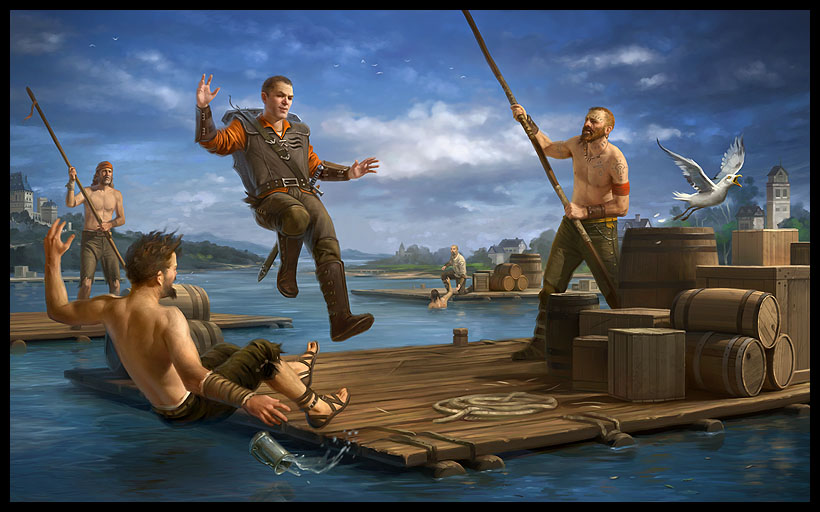
Sunday, July 5, 2015

Jumping

The house rules below handle jumping over one or two squares on the map.


  • When you attempt to jump over a single square, roll +STR modifier and consult the table below.  You can add Athletics or Acrobatics proficiency.
  • When you attempt to jump over 2 squares, roll at -10.
  • If you have a running start of at least 10', you gain Advantage.
  • If you land in difficult terrain, you must make a DC10 DEX(Acrobatics) Check or fall prone.

Jumping - d20+STR mod

1 or less - You miss completely, landing prone in the square you attempted to jump over.
2 - If you were jumping over a pit, you jump short, but manage to grab the edge of the pit and save yourself from falling in.  Next turn, you can pull yourself up and out using your full movement.  If you weren't jumping over a pit, consider this a 3 result.
3 - You land badly, falling prone and sprain your ankle (-10 movement until the next Long Rest).
4 - You land roughly, falling prone and taking 1d4 bludgeoning damage.  This damage cannot reduce you to 0 hit points.
5 - You clear the jump, but land prone and slide an additional square in the direction that you jumped.
6 - You realize at the last minute that you misjudged the jump, and stop short just prior to jumping, ending your Movement.
7-10 - You make the jump and land in fair shape, although your Movement is ended this turn.
11-18 - You leap gracefully and land spot on.  You can continue your turn normally.
19+ - Your jump was perfect.  Your confidence is boosted so much so that next turn you can jump at Advantage.

Monday, June 29, 2015

Streamlined Wilderness Travel

This house rule for streamlined wilderness travel consists of one set of rolls to get from point A to point B.  The DM might consider breaking up a very large journey into several of these rolls, if different terrains will be traversed.  I'm not going to bother with variable travel speeds for these streamlined rules.  Again, the inspiration here is from Dungeon World.

When undertaking a wilderness journey, each PC in the group must take on one of the following roles.  Make one set of rolls for the entire journey, and have everyone mark off rations consumed.

Navigator Role
WIS(Survival) Check, DC determined by terrain (DMG page 112).  Failure indicates that the party becomes lost roughly half way to the destination.  Mark off rations for half the length of the trip (rounding up), plus one additional ration.  Then make another set of rolls for the remaining trip.  Consecutive failures could mean the PCs wind up somewhere other than they intended!

Scout Role
WIS(Perception) Check.  Success indicates that the party gains the drop on any encountered threat.

Forager Role
WIS(Survival) Check (DMG page 111).

Tracker Role
WIS(Survival) (DMG page 244).

Random Encounters
If any of the dice come up equal or less than the total number of days in they journey, a wilderness threat is encountered along the way.  This nicely factors in a greater chance of a random encounter for larger wilderness parties.  After all, the more people traipsing trough the forest, the easier for the owlbears to hear them, no?


Sunday, June 28, 2015

Streamlined Encumbrance

This is a house rule for a streamlined encumbrance system for D&D 5e.  It borrows the encumbrance mechanics from Dungeon World.  The goal is to make encumbrance easier to calculate and manage at the table without hand-waving it completely.

Item Weight

I'll be giving out item cards at the table to PC gear.  Each item will have an abstracted Weight value, which is roughly the item's actual weight divided by 10.  But, if an item weighs at least 2#, it has a minimum Weight of 1.  For example, a Shortsword has a Weight of 1, while a suit of Plate Armor has a Weight of 6.

Carrying Capacity

Your maximum carrying capacity is your Strength score + 10.

Encumbrance

If you carry Weight in excess of your Strength score, you are encumbered (PHB page 176).  If you carry Weight in excess of your Strength score + 5, you are heavily encumbered.